
A team of developers can adhere to safe coding practices, maintain dependencies updated, and still create a vulnerability that nobody is aware of. It’s simple: Real attacks aren’t based on an outline. A hacker could use an authentication flaw coupled with a vulnerable API endpoint, evade an automated password reset workflow, or find that a client account has access to other tenant’s personal information.
Security assurance Brisbane companies use penetration testing to examine systems from an adversarial angle. Instead of determining whether security controls are present, experienced testers inquire if those controls are actually able to be manipulated.
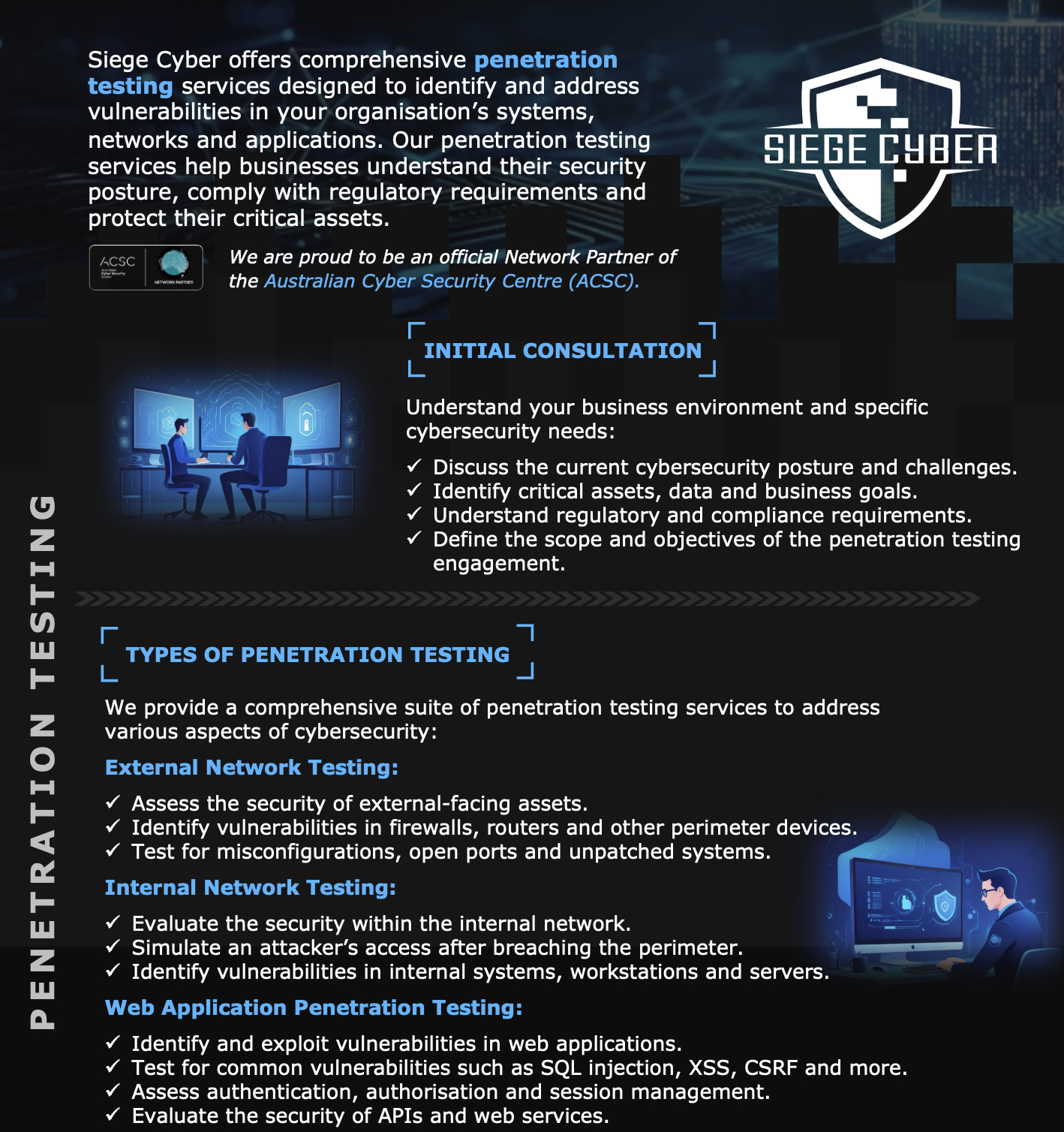
This distinction is critical for Australian businesses that handle sensitive information like customer information or financial records, medical records, or any other assets.
Scanning with automated tools only tells a portion of the truth
Vulnerability scanners may be helpful. They can quickly spot outdated software, insecure headers well-known CVEs, and clear configuration problems. They don’t discern how an application ought to behave.
Imagine a site for customers who want to access invoices of a different business and also change their account number. The server can return perfectly valid responses which is why an automated scanner doesn’t see anything unusual. Human testers can detect the problem immediately.
Web penetration testing is a blend of automation and manual investigation. Testers look at authentication sessions, session, access controls and injection risk, API behavior, weak configurations as well as business processes trying to find the right combination of flaws that could create meaningful impact.
SaaS environments are not without their own security concerns
Testing multi-tenant cloud apps is especially important, because a mistake can impact many clients at once.
Saas penetration tests should cover tenant isolation and privileged features. It should also cover API authorization, role change and account recovery, as well as data leakage, as well as integrations with external services. The tester should be able to discern not just whether a feature functions, but also if it can be altered in a way that the team behind the development never anticipated.
A user who has a basic task, such as might not be able to access administrative functions through the interface. It does not always mean they can’t use it directly. It is vital to verify the API rather than just observing what appears to be the API.
Modern web applications offer a greater attack surface
Applications of the present often integrate JavaScript front-ends and APIs, cloud service providers microservices, identity providers, and cloud service providers. The weakness could be in any component, or in the trust relationships between them.
Thorough web app penetration testing follows those connections. Testing may include examining how tokens are generated and whether the endpoints that are sensitive enforce authentication on a regular basis, or how the data controlled by the user moves between different services.
Siege Cyber is an expert in this type of application testing. They use modern frameworks, such as APIs and cloud-hosted platforms, and they also test complicated application architectures.
A useful report should help the developers to fix the issue.
Discovering vulnerabilities is only a small portion of the task. When security experts are able to reproduce an issue, understand its risk and confidently remediate it, security testing is most useful.
Siege Cyber reports contain evidence reproducibility steps, as well as risk ratings. They also provide impacts analyses, practical remediation advice, and a comprehensive analysis of the impact. The executive summary of the risk is distributed to business partners and the technical team receives the details needed to address it. There is the option to take action on critical findings during the engagement, rather than waiting for the final reports.
Retesting the system following remediation gives an additional level of security in that it proves the issue was fixed without having to design a new one.
For those who want independent validation, proof of compliance, or greater confidence before the release of a major version, penetration testing provides something software and policies are not able to provide be able to provide: a controlled chance to discover how skilled attackers could actually attack the system. Finding that answer before an actual adversary does is what makes the test useful.